

META Advertising Has Tanked in 2026: Botched Algorithm Change
In January 2026, Meta implemented a series of foundational shifts to its advertising ecosystem, primarily revolving around the permanent removal of legacy manual controls and a significant overhaul of attribution windows.
According to reports from industry leaders like Jon Loomer, and Meta’s own Newsroom, the platform is transitioning away from “technical media buying” toward an AI-driven “Goal-Only” system. Here is the summary of the key changes.
What Happened to META Advertising in 2026?
In mid-January, Meta accelerated the rollout of its Andromeda architecture. This update fundamentally changed how ads are ranked and delivered.
- Creative-Led Targeting: The algorithm now prioritizes the “contextual signals” within your ad creative (images, text, and video hooks) over manual interest selections. It uses computer vision and natural language processing to decide who sees your ads, effectively making the creative the primary targeting lever.
- Account Simplification: Meta now penalizes fragmented account structures. The new standard is to run fewer campaigns with broader targeting. Agencies are being pushed to consolidate multiple ad sets into single, high-budget pools to feed the machine learning model more data, more quickly.
Attribution Window Overhaul (January 12)
One of the most disruptive changes reported by Dataslayer and other technical audits occurred on January 12:
- Removal of Long View-Through Windows: Meta permanently removed longer view-through attribution windows (specifically the 28-day window) from its standard Insights API.
- Impact on Reporting: For businesses with longer sales cycles or those relying on “awareness” video ads, conversion numbers may look 30–40% lower on paper than they did in December. This change essentially forces agencies to rely more on the Conversions API (CAPI) and first-party data rather than platform-based tracking alone.
Why Meta Ads Removed Interest Targeting?
On January 15, Meta stopped delivery for thousands of “discontinued” interest-targeting categories.
- Consolidation of Interests: Many niche interests (e.g., specific music genres or diet types) were merged into broader buckets.
- Mandatory Updates: Campaigns that were still using legacy interest stacks from 2024–2025 were automatically paused or shifted into “broad” delivery, requiring agencies to manually audit and update account structures to maintain performance.
Bidding & “Advantage+” Dominance
The shift away from manual bidding is no longer a suggestion; it is becoming a mechanical necessity for scale.
- Advantage+ Automation: Meta’s January updates gave Advantage+ Shopping and Lead Campaigns higher priority in the auction. Reports show that these automated campaigns often see 15–20% lower Cost Per Acquisition (CPA) compared to manual setups because they have access to “real-time auction multipliers” that manual bids cannot replicate.
- Cost Caps & Bid Caps: While manual bidding (like Cost Caps) still exists, it is being relegated to a “gatekeeper” role for retargeting or low-budget experiments. Meta’s AI now predicts “conversion probability” with higher accuracy, often making manual bid tweaks counter-productive.
How Advertisers Can Adjust to META Changes
The consensus among experts is that the “technical” part of PPC ad management, tweaking bids, testing 50 different interest groups, and manual placement selection—is being phased out by the platform. The “agency of 2026” is expected to focus on:
- Creative Velocity: Producing high volumes of diverse creative assets (Social-Native, UGC, and Founder-led) to “train” the AI.
- Data Integrity: Ensuring CAPI and offline conversion tracking are perfectly synced.
- Strategic Guardrails: Setting the right business goals and budgets while letting the machine handle the micro-optimizations.
META Advertisers Are Not Happy in 2026
There is a massive “shouting match” happening in the industry right now—particularly on Reddit (r/FacebookAds) and within high-level media buying circles.
The issue where people claim they “never filled out the form” has become a systemic plague in early 2026. It’s a direct byproduct of the algorithm prioritizing volume over intent to make its new AI models look like they are succeeding.
Why META Advertising Is Generating Fake Leads In 2026
The January “Andromeda” update and the push for Advantage+ Leads created three specific “leaks” in the bucket that are hurting agencies like yours:
- The “Fat Finger” & Auto-Fill Trap: Meta’s Instant Forms are now so “low-friction” that they are almost accidental. With one-click auto-fill, a user scrolling on their phone can submit a form with a 10-year-old email address and their full name before they even realize they’ve clicked an ad. By the time you call, the “micro-moment” is gone, and they genuinely don’t recall the interaction.
- The “Account Poisoning” Loop: This is the most dangerous part. If the algorithm finds a “pocket” of users who accidentally click (e.g., bots or low-intent scrollers), and those people “convert” by submitting the form, the AI sees that as a “Success Signal.” It then spends more of your budget hunting for more of those same low-quality users, effectively “poisoning” your ad account with junk data.
- The “Audience Network” Garbage: In an effort to combat manual bidding, Meta is pushing ads into the Audience Network (third-party apps and games). Recent Q1 reports show click fraud rates as high as 60-70% on the Audience Network. These are often bots or users forced to click an ad to “unlock” a game level, leading to fake or “phantom” form fills.
META Advertising Tactics to Fight Back
Since Meta is trying to take away the manual levers experienced marketers use to win, agencies are moving toward “High-Friction” strategies to force the AI to find real humans:
| Strategy | How it works | Why it helps |
| The “Higher Intent” Filter | Change form settings from “More Volume” to “Higher Intent.” | Adds a “Review Your Info” slide that stops accidental “fat-finger” submissions. |
| The “Human Verification” Question | Add one custom, non-autofill question (e.g., “What is your biggest plumbing concern?”). | Bots can’t answer it, and scrollers have to stop and type, which cements the brand in their memory. |
| The “Website Conversion” Pivot | Stop using Instant Forms; send traffic to a dedicated landing page. | Harder to get the lead, but someone who leaves Facebook to fill out a form is 5x more likely to be a real prospect. |
| Sales Objective “Hack” | Run a Sales campaign but optimize for the “Lead” pixel event. | This tells the AI to find “Buyers” rather than just “Form-Fillers,” significantly cleaning up the quality. |
The Consensus
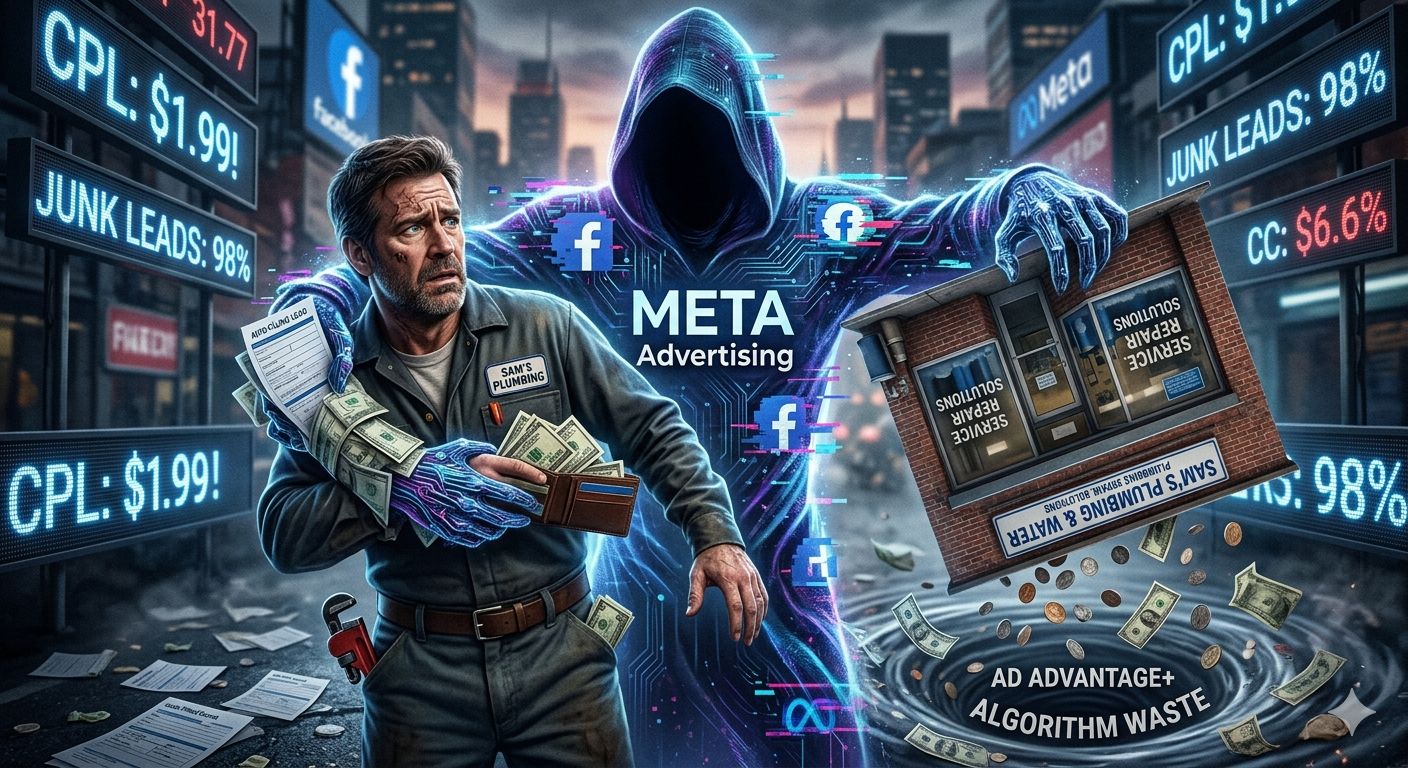
Lead quantity is now a vanity metric. If you measure success by CPL (Cost Per Lead), Meta’s AI will give you $2 leads all day that are 100% junk. The focus has shifted to Lead Quality Optimization—basically putting more hurdles in the way to ensure only the “little guys” who actually need help get through. You just can’t do this on your own any more.
If you’re ready to weather the storm and turn algorithm chaos into growth, eMaximize has been an extremely reliable digital marketing agency for small businesses since 2008. We provide the guidance, strategy, and execution you need without the big agency fees.
Kindly send us a note or give us a call and we can start your free analysis and show you how eMaximize can prepare you for this massive change, like we do for all our clients!
Thanks for reading our digital marketing for small business blog!
Proudly Serving Clients in Los Angeles & Beyond
eMaximize has been an extremely effective digital marketing agency for small businesses in Los Angeles and across the United States. We provide the guidance, strategy, and execution you need without the big agency fees. To read reviews or get contact information see our Google Map Listing.
